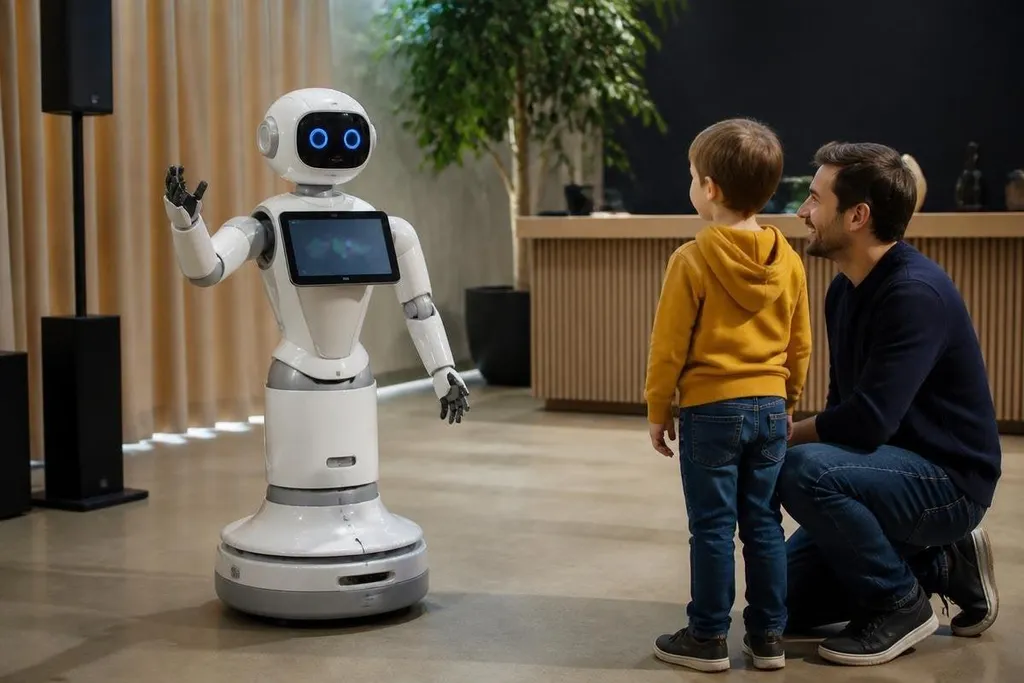
A robot that sings, dances, or tells jokes has seconds to earn a person’s attention. Future models will need to respond to people, manage their battery, and stay safe when the room gets busy.
- The useful job: repeatable interaction, not a one-time trick
- The hardware: microphones, speakers, cameras, motors, and a charging plan
- The buying test: ask what the robot does after the first five minutes
The show starts with a real task
Entertainment robots need a job that can be repeated.
That might mean leading a museum activity, running a game at a venue, guiding guests through a queue, or reacting to movement on a stage. One that only waves on command will have little to do once the first demo ends.
The task also sets the hardware needs. A robot speaking to a crowd needs microphones that can separate voices from background noise. It needs speakers that people can hear without standing close to its body. A stage robot needs motors that can repeat the same movement without overheating.
That connection matters for buyers. A venue manager should ask how many interactions the robot can handle before a staff member must reset it, reload content, or move it back to a charger.
Sensing people is harder than playing a file
A recorded line is easy to repeat. A useful exchange needs the robot to detect a person, hear a request, choose a response, and signal what it will do next. Cameras can help locate people and objects, while microphones pick up speech. Each sensor adds a failure point when lighting, noise, or crowd size changes.
The robot also needs a clear limit. If it can't understand a question, it should ask the person to repeat it or hand the task to a staff member. Pretending to understand creates longer delays than a plain error message.
Entertainment robots need more than a polished launch video. Robot24.com entertainment robotics reporting can tie a public demo to its task, setting, date, and human support. The next test is whether its movement helps the audience or gets in the way.
Movement has to serve the audience
Movement attracts attention, but motion without a reason becomes noise. A small head turn can show that the robot heard someone. An arm gesture can point toward a display. A change in position can make a stage routine easier to see. Each motion should connect to the task.
Safety sets the outer limit. Any robot operating near children, guests, or performers needs low-speed movement, a reachable stop control, and a clear path around its body. The design also needs to account for loose clothing, bags, cables, and people stepping into the robot’s route.
The battery plan matters just as much. One spending its working day talking through speakers and moving motors will need charging breaks. Those breaks should fit the venue’s schedule, since a silent robot in the middle of a paid event becomes a staffing problem.
The software needs a human fallback
Entertainment settings change by the hour. A school group asks different questions from a trade-show visitor. A concert crowd creates more noise than a quiet gallery. The robot’s software needs ways to change its language, response length, movement, and volume without a technician rewriting the whole system.
A staff member should also be able to pause the robot, see its status, and take over an interaction. Remote control can help when a question falls outside the robot’s script, but it brings its own needs: a reliable network, a trained operator, and a clear handoff.
The open question is persistence. The machine may perform well during a short event, yet struggle after hours of repeated speech, charging, movement, and minor knocks. Public trials need to measure those conditions instead of relying on a polished demonstration.
A practical buying check
Use these points before approving a pilot:
- Name the task: write down the repeated interaction the robot must perform.
- Count the resets: record how often staff need to restart, move, or recharge it.
- Test the room: check speech recognition with the real lighting and crowd noise.
- Check the stop path: place the emergency control where staff can reach it quickly.
- Set the handoff: decide when a person takes over and how the robot signals that change.
- Measure the trial: track completed interactions, failed responses, downtime, and staff hours.
I'd skip any entertainment robot whose main proof is a short routine with no task data behind it. A useful purchase needs a repeatable role, a charging plan, and a human who can step in when the software reaches its limit.
The next product worth watching is the one that publishes those results after a full day in a real venue, not the one with the longest dance.